
FAQs
EVERYTHING YOU NEED TO KNOW
Need something cleared up? Here are our most frequently asked questions.

1. Olympic Voodoo Poker Club offers the following games:
Texas Hold’em
Omaha
Five Card Omaha
Seven Card Stud
Five Card Stud (Sökö)
Crazy Pineapple
2. Maximum number of players at the poker table:
Texas Hold’em, Crazy Pineapple – 10.
Omaha, Five Card Stud (Sökö) – 9.
Seven Card Stud, Five Card Omaha – 8.
3. Smoking at the poker tables is prohibited.
4. Players are prohibited from:
Inappropriate behavior towards casino management, staff, and other players.
Interfering with the dealer's conduct of the game in any way.
Throwing cards or chips.
Hiding game chips.
Showing their cards to other participants during the game.
Damaging casino equipment.
Cheating (dishonest play).
Keeping drinks, cigarettes, wallets, and other unrelated items on the table.
5. As a result of a client’s inappropriate behavior, the Tournament Director has the right to:
During cash games, exclude a participant for 10 minutes or prohibit participation in the game and presence in the poker area.
During tournaments, exclude a participant for 10 minutes or longer; fully disqualify from the tournament and prohibit presence in the poker area (if a player is disqualified from the tournament, the ticket money is non-refundable).
6. The Tournament Director has the right to limit the use of mobile phones or other electronic devices at the poker table.
7. Talking on the mobile phone during a hand is not allowed and may result in the Tournament Director declaring the player's cards as a Dead Hand.
8. Spectators are prohibited from commenting, giving advice, or distracting players during the game. Tournament Directors may ban spectators from the poker area if requested by players.
9. All poker games use special chips (tournament chips and cash chips).
10. During the game, players must communicate in a language understandable to both the dealer and the Tournament Director (Latvian, Russian, or English).
11. Players are allowed to play only in their seat and with their own chips, and all decisions related to the game must be made independently.
12. The player is responsible for the security of the cards dealt to them.
13. Participants must not disclose information about their cards to each other.
14. If during the game a participant reveals their cards to another participant, then the rest also have the right to see these cards (Show one - Show all) – even if the participant folds, they must not show the cards to another player, regardless of whether that player is still in the game or not.
15. During the game, players must keep their cards on the table so that they are visible to everyone at the table.
16. If a player holds their cards so that another player can see them, the Tournament Director has the right to warn or consider these cards as a Dead Hand.
17. At the start of card dealing, cards of absent participants will be considered Dead Hands and collected starting from the player after the Big Blind. This rule also applies to players on the Blind positions.
18. If a player wishes to make a bet consisting of several chips, it must be done in one motion. Additional chips placed later are not accepted and such a bet is called a String Bet.
19. If a player makes a String Bet:
If there are already bets on the table, the String Bet is accepted as a Call.
If the String Bet is the first bet, only the first chip touched to the table is accepted.
20. If there are bets on the table and the player without comments places one chip, the value of which is higher than the last bet, this bet is accepted as a Call.
In case the chip value is lower than the previous bet (including All In situations), the following rules apply:
In multi-pot situations (more than 2 players), the player must confirm that this is a Call. If the player does not confirm Call, they lose this bet, cannot raise, but may fold.
In Heads-Up situations – automatic Call.
21. If a player who has the first word in the betting round places one chip without comments, the value of which is higher than the minimum bet, this bet is accepted as the maximum possible bet for the current game.
22. If there are bets on the table and the player without comments places a bet consisting of several chips, which totals at least 50% of the minimum Raise, it is accepted as a Raise; if less, as a Call.
23. If the player has verbally declared the amount of their bet, the bet must be made. In this case, String Bet is allowed.
24. Decisions related to the game are made by players in the proper order. If a player acts out of turn:
Says Check or makes a Bet, this remains valid if the previous player to act checked or folded. If the previous player made a bet, the out-of-turn player may change their decision (Call, Raise, Fold);
Matches a Call or raises, this remains valid if the previous player to act called or folded. If the previous player raised, the out-of-turn player may change their decision (Call, Raise, Fold);
Folds, cards are not returned;
Upon repeated violations of the above points, the player may receive a warning or a game suspension.
25. In Pot Limit and No Limit games, the following minimum Raise rules apply:
The first Raise is always double the last bet.
All subsequent Raises differ from the previous Raise.
26. If a player reveals their cards out of turn, they remain in the game but with limited options – only Check, Call, or Fold. After the hand, the Poker Director issues a warning or excludes the player from the game for 10 minutes. Repeated violations may result in disqualification.
27. At the showdown, players must reveal all their hole cards. The first to reveal cards is the player who made the last Bet or Raise and others have called. If there were no bets in the last betting round (all players checked), the first to reveal is the player first to the left of the Button. Then other players reveal their cards clockwise.
28. Cards Speak – the player with the best combination wins, even if the dealer or player has made an error in determining the combination.
29. Only 5 cards are used to make the combination. The 6th or 7th card cannot determine a win or loss.
30. Suits are not taken into account when determining the best combination.
31. If the pot cannot be divided evenly, the odd chip is awarded:
In Flop games (with Button) – to the first player to the left of the Button;
In Stud games (without Button) – to the first player to the left of the dealer.
32. If there is more than one pot (side pots), the players contesting the last side pot open their cards first (starting from the last side pot and ending with the first).
33. Misdeal is a situation where cards must be shuffled and dealt again. Misdeal includes the following situations:
The first dealt card is accidentally exposed.
More than one card is accidentally exposed during dealing.
The dealer starts dealing from the wrong player.
The dealer skips a player during dealing, making it impossible to arrange cards correctly.
A player is dealt fewer cards than necessary (except if the player is on the Button position and the missing card can be dealt).
A player is dealt more cards than necessary (except if the player is next to the Button and the dealer immediately notices the error; in this case the extra card is taken back and used as a burn card).
34. Claims regarding previous hands are not accepted in a new hand.
35. In case of dishonest play, the casino management has the right to prohibit two or more players from playing at the same table.
36. In case of dishonest play, the Tournament Director has the right to inspect a player's cards.
37. In decision making, the Tournament Director follows fair play rules. For a fair decision in non-standard situations, formal technical rules may sometimes be disregarded.
38. All problems and claims are resolved on site, and the final decision is with the Tournament Directors. Claims not made in a timely manner will not be considered.
1. Only cash chips are used in Cash Game sessions.
2. Bets made in cash are not accepted. Cash can be exchanged for chips only before the start of the hand.
3. To participate in the game, a player must register with the Tournament Director. If the player does not arrive before the game starts, they may lose their seat.
4. A player participating in a tournament cannot register for Cash Game.
5. A maximum of 9 players can play simultaneously at one Cash Game table.
6. The Dealer Button is always used in Cash Game. The Dealer Button is always played before the start of the Cash Game.
7. The minimum and maximum buy-ins are determined by the Tournament Director depending on the game type and blind sizes.
8. A new player can join the game by paying the minimum buy-in. Buy-in can be paid in cash or with cash chips.
9. A new player has the right to choose a free seat at the table. After the choice is made, no one else can claim that seat.
10. A player can change their seat at the table. If the player misses the Big or Small Blind due to seat change, they still must pay the missed bet.
11. If a player misses mandatory bets during seat changes, they must still pay those bets.
12. A new player may start playing by placing a bet equal to the Big Blind (New player’s Blind) or wait until it is their turn to post Big Blind or Straddle.
13. Cards must not be dealt to a player without chips. Cards can only be dealt if the player has chips equal to or greater than the Big Blind amount.
14. During Cash Game, players must be present at the table to participate in a hand. If a player is not at the table, cards will not be dealt to them. If the player misses Big or Small Blind, they must pay the missed bet.
15. Buy The Button means that a player joining between the dealer button and small blind can pay both Big Blind and Small Blind to immediately enter the game and receive the dealer button in the next hand.
16. It is possible to place a Straddle bet in Cash Game: the first Straddle bet and all subsequent Straddle bets are considered Live Straddles. (If a new player joins the game immediately after the SB and BB positions (or after other players' Straddle bets), they may optionally place their own Straddle bet.)
17. During the game, a player may make a Short Buy-in (half the minimum buy-in) no more than once.
18. The table minimum and maximum can be changed only with the Tournament Director/Manager’s approval and if the other players at the table agree.
19. Table stakes means that only chips on the table can be used in the game. Players are not allowed to add or remove chips during a hand, except when paying for drinks, food, or tipping.
20. Players are prohibited from lending or passing chips to each other at the table.
21. During the game, a player is allowed to take a 30-minute break with the Tournament Director’s permission. If a player leaves the table without permission, they may lose their seat.
22. If a player cannot make a decision in a timely manner, the Tournament Director may set a specific time limit for making the decision.
23. If a player leaves the table after finishing the game and returns within one hour, they must sit down with the same amount they had when they left.
24. The casino charges a 5% rake with a cap of €15.
25. The rake is always taken from the Main Pot.
26. If the game ends before the Flop (in flop games) or before the second exposed card (in Stud games), no rake is taken. ("No Flop – No Rake")
27. Run It Twice:
If two or more players have gone All In and the dealer is ready to reveal the remaining cards, players can choose to Run It Twice.
If one player proposes this and all others involved agree, the dealer:
- If players went All In before the Flop, reveals the first Flop, Turn, and River (burning the necessary cards), then burns another card and reveals a second Flop, Turn, and River (again burning the necessary cards).
- If players went All In after the Flop, reveals the first Turn and River (burning cards), then burns another card and reveals a second Turn and River.
- If players went All In after the Turn, reveals the first River (after burning a card), then burns another card and reveals a second River.
In situations with three or more players where there is a Main Pot and Side Pot(s), and one player refuses to play two Flops, other players with Side Pots are allowed to play two Flops, but the Main Pot applies only to the top cards (first Flop, Turn, River).
*If the All In player loses the Main Pot, the other players may play two Flops including the Main Pot.If playing 5 Card Omaha at a Cash Game table, cards can be Run It Twice only if there are 7 or fewer players at the table.
1. A tournament is a competition where players pay a certain entry fee. The prize pool is formed from the collected money and is distributed among the winners according to a specific system. The number of paid places depends on the number of participants.
2. Olympic Poker Club offers the possibility to play different types of tournaments:
Rebuy – a tournament where players can rebuy chips within a certain time period if they run out of chips.
Freezeout – a tournament where players have no option to rebuy chips.
Knockout – a tournament where players receive a cash chip prize for knocking out other players.
3. To participate in a tournament, a player must register and pay the entry fee at the Olympic Voodoo Casino cashier.
4. The casino reserves the right to limit tournament registration rules.
5. If the number of applicants exceeds the allowed number of players in the tournament, a waiting list is created where players can register but can participate only if a spot frees up in the main list:
During the Rebuy period for "Rebuy" tournaments.
At the time designated by the director for "Freezeout" tournaments.
6. The position on the waiting list is individual and cannot be transferred to another person.
7. The tournament takes place only if there are at least 4 participants. Otherwise, the tournament will be canceled and those who have already paid can get a refund.
8. At the start of the tournament, all participants receive an equal amount of tournament chips. These chips can be used only in the tournament and have no cash value.
9. Players are forbidden to give their chips to other players.
10. Players are forbidden to take chips outside the casino premises.
11. Seats at the table are drawn among all tournament participants. Players are not allowed to exchange assigned seats.
12. Players must play the tournament themselves – using another player to play on their behalf is forbidden. Also, giving advice to spectators or other players on decision-making is prohibited.
13. If a player has paid the entry fee but is known to be late, their chips are played in the tournament with the others. The dealer posts all forced bets on behalf of the late player.
14. A player can get a refund of the paid entry fee in the following cases:
If the tournament is canceled for some reason.
If the player notifies that they will not attend the tournament before it starts and has a valid reason with the tournament director's approval.
15. A player who has left the table still receives cards and must post Ante or Blind bets. The dealer has the right to post forced bets for the absent participant.
16. Cards are dealt to all tournament participants regardless of whether the player is present or not.
17. If a player is not at the table after the first card is dealt, their cards are immediately mucked, even if the player is in a blind position.
18. Minimum bets (Small/Big Blind, Ante, Forced Bet) increase according to a predetermined schedule.
19. During the tournament, all tables must have an equal number of players. The number of players at the tables is regularly adjusted as players leave the tournament.
20. Table balancing is done as follows: the player who finishes the game vacates their seat, which is taken by the player in the BB position.
21. Seats from a disbanded table are always drawn by lot.
22. Seats at the final table are always drawn by lot.
23. During table balancing, players must immediately move to their assigned seats.
24. If two or more players leave the tournament, their seats are assigned based on chip count (the player with more chips takes the better seat).
25. When only two players remain in the tournament, the player with the Button posts the Small Blind and the other posts the Big Blind. These rules apply to Heads-up tournaments as well.
26. Bets, levels, and starting chip stacks (tournament structure) are planned in advance, and every player can receive this information before the tournament starts.
27. The casino reserves the right to change the planned tournament structure before the tournament begins, and all participants must be informed beforehand.
28. If a player takes too long to make a decision, any player at the table may request the Tournament Director to grant 30 seconds of “Time.” If after the minute the player still hasn't made a decision, the director starts a 10-second countdown. After the countdown, the player's hand is automatically considered a Dead Hand (Fold). (In Turbo tournaments, this time is 15 seconds).
29. Time” can only be requested by a player for the table they are playing at. The Tournament Director may refuse the request if deemed unnecessary.
30. Manipulating the “Time” request is forbidden, and violations may result in warnings or penalties.
31. Only tournament chips are allowed on the table during the tournament, except for chips used as “Card Cap” (a chip or talisman of luck) or cash chips used as Terminator chips in Terminator tournaments.
32. Hand rankings are determined only by revealed cards. Combinations verbally announced by players are not valid.
33. After the designated level time expires, the next level begins with the next deal. If the dealer has started shuffling (strip shuffle), the current hand is played with the old blinds.
34. Folded cards are immediately moved to the muck and no one has the right to look at them.
35. If only one player is left for a prize or ranking point, dealing across all tables happens simultaneously until one player leaves the tournament (international tournaments).
36. If the dealer collects a player's cards who did not protect them, that player cannot get back the chips they have bet. The exception is if the player made a Raise and no one called.
37. If a player moves from a disbanded table to another and is between Small Blind and Button, they miss that deal, and the Button moves past them to the next player in the next deal.
38. Players are forbidden to comment on possible combinations related to folded or hole cards.
1. Freezeout Tournaments
At the start of the tournament, all players receive an equal number of chips. No rebuys are allowed. Once a player loses all their chips, they are eliminated. The game continues until one winner remains.
2. Rebuy Tournaments
Within a specified time period, players have the opportunity to purchase additional chips (rebuy) if they run out. After the rebuy period ends, the tournament continues as a freezeout.
3. Re-entry Tournaments
After being eliminated, a player can re-register for the tournament by paying the buy-in again. Unlike a rebuy, the player starts fresh, often at a different table.
4. Add-on Tournaments
At a specific point (usually after the rebuy period), players can purchase additional chips (add-on). To make an add-on, the player must have at least one chip. If they have none, they must first rebuy before adding on.
5. Unlimited Rebuy Formats
Unlimited Rebuys: Players can rebuy an unlimited number of times up to the starting chip amount, if their stack is equal to or lower than the starting stack. Only allowed during the rebuy period and between hands.
Unlimited WILD Rebuys: Players can rebuy unlimited chips regardless of their current stack size.
6. Double Chance Tournaments
At the beginning, players receive half of their total starting chips. The other half can be requested once, for free, at any point during the first three levels—only between hands.
7. Sit & Go Tournaments
The tournament begins as soon as a specific number of players register (e.g., 6, 9, or 18). There is no scheduled start time. These tournaments are smaller and faster.
8. Multi-Table Tournaments (MTT)
Large tournaments with many players split across multiple tables. As players are eliminated, tables are consolidated until one final table and one winner remain.
9. Satellite Tournaments
Winners receive entry tickets to another, higher buy-in tournament. This is a great way to qualify for prestigious events at a lower cost.
10. Bounty Tournaments
Players receive a cash reward for eliminating other players. Part of the buy-in goes toward the bounty pool.
11. Progressive Knockout (PKO)
A special bounty format. When a player eliminates another, they receive 50% of the opponent’s bounty as a reward, and the other 50% is added to their own bounty. The more players they knock out, the higher their own bounty becomes.
12. Mystery Bounty
For each eliminated player, a random (mystery) prize is awarded. The value is revealed only after the elimination, adding excitement and unpredictability to the game.
13. Double or Nothing Tournaments
Half the players double their buy-in, and the other half win nothing. The tournament ends when the required number of players are eliminated.
14. Turbo and Hyper-Turbo Tournaments
Turbo: Blind levels increase faster than in standard tournaments.
Hyper-Turbo: Blind levels increase even faster, making the pace of play much more aggressive.
15. Deep Stack Tournaments
Players start with a larger-than-usual amount of chips compared to the blinds. This allows for deeper strategy and longer gameplay.
16. Terminator Tournaments (Life Chip)
A freezeout variant where each player also receives a Life Chip with a cash value. If a player goes all-in and loses, their Life Chip is awarded to the opponent. Every time a player goes all-in, they must include their Life Chip if they still have it.
17. Big Blind Ante (BBA)
In BBA tournaments, only the player in the big blind pays the ante, which speeds up gameplay and reduces dealer error.
Priority: If a player doesn't have enough chips for both the big blind and the ante, the big blind is paid first, and the ante only if chips remain.
18. Ante Only No Limit Texas Hold’em
In this format, players only pay antes in each hand—there is no small or big blind.
These formats offer diverse gameplay dynamics, strategic challenges, and prize distribution models—making poker tournaments engaging and suitable for players of all styles and experience levels.
This is the most popular and simplest version of poker. Players are dealt two cards each, and five community cards are revealed on the table. Players can form a five-card combination using one or both of their own cards together with the community cards. The game consists of four betting rounds, starting from the position after the Button, which moves one step clockwise after each hand.
Blinds
Before the game starts, and before players are dealt cards, two players after the Button place forced bets called Blinds. Blinds are necessary to ensure a starting amount in the pot. The first player after the Button posts the Small Blind, and the second posts the Big Blind. The Big Blind is usually twice the size of the Small Blind.
Pre-Flop
Players are dealt two hole cards. After the cards are dealt, the next player after the Big Blind starts the betting round. This player can call (match the previous bet), raise (increase the bet), or fold (discard their cards and leave the hand). When the action reaches the Big Blind, they can check (continue without adding more chips) if no raise was made. If there was a raise, the Big Blind can fold, call, or re-raise. Once all bets are matched, the dealer collects the bets and the next round begins.
Flop
Three community cards are dealt face up on the table. Players can use these cards to form their combinations. After this betting round, the game continues.
Turn
The fourth community card is dealt face up, followed by the next betting round.
River
The fifth and final community card is dealt face up, followed by the last betting round.
Showdown
After the final betting round, players reveal their cards to determine the winner. To claim the pot, a player must show both hole cards. If two or more players have identical combinations, the pot is split equally.
This game is very similar to Texas Hold’em, but unlike Texas Hold’em, players are dealt four hole cards, and five community cards are dealt on the table. Players must use exactly two of their hole cards and three of the community cards to form their five-card combination. The game has four betting rounds, starting from the position after the Button, which moves clockwise after each hand.
Blinds
Before the game starts and cards are dealt, two players after the Button place blinds to ensure a pot. The first player after the Button posts the Small Blind, the second posts the Big Blind, which is usually twice the Small Blind.
Pre-Flop
Players are dealt four hole cards. The player after the Big Blind starts the betting round, with the options to call, raise, or fold. The Big Blind can check if no raise was made or fold, call, or raise if there was a raise. After all bets are equalized, the dealer collects the bets and the next round begins.
Flop
Three community cards are dealt face up. Players use these cards with their hole cards to form combinations.
Turn
The fourth community card is dealt face up, followed by a betting round.
River
The fifth community card is dealt face up, followed by the final betting round.
Showdown
After betting ends, players reveal their cards. A player claiming the pot must show all their hole cards. If players have identical hands, the pot is split.
Until recently, 7 Card Stud was the most popular poker version until Texas Hold’em overshadowed it. This variant differs from Texas Hold’em and Omaha and requires patience, but is very engaging.
Before the game starts, players place mandatory Ante bets. There are no community cards in Stud poker. Instead, the dealer deals three cards to each player clockwise. The first two cards are dealt face down and the third face up.
There are five betting rounds that proceed clockwise.
Betting start
The player with the lowest (in Split Limit) or highest (in Pot Limit) visible card starts and places the initial bet. If two or more players have the same rank, suit order is used: clubs, diamonds, hearts, spades.
3rd Street
After the initial bet, each player can fold, call, or raise up to the limit, starting left of the bettor.
4th Street
A fourth card is dealt face up. The player with the best visible hand starts the betting round and can double the bet if they get an up pair.
5th Street
The fifth face-up card is dealt. The player with the best visible hand starts betting.
6th Street
The sixth face-up card is dealt. The player with the best visible hand starts betting.
7th Street or River
The last, seventh card is dealt face down. The player who started the previous round begins betting.
Showdown
The player with the best five-card hand wins.
Each player is dealt two cards: the first face down (hole card) and the second face up. The hole card is hidden from other players.
There are four betting rounds. After dealing the first two cards, the first betting round begins. Then the third, fourth, and fifth cards are dealt face up, each followed by a betting round.
Players place an obligatory Ante before dealing.
Bring-in
The player with the lowest (Split Limit) or highest (Pot Limit) card starts and places the initial bet. If tied, suits decide in alphabetical order: clubs, diamonds, hearts, spades.
Betting order
Soko has four betting rounds. After the first two cards, the first betting round starts. Then each new card is dealt with a betting round after.
Showdown
When betting ends, players reveal cards and the best five-card combination wins. In case of ties, the pot is split equally. Any leftover chip goes to the player left of the dealer.
The player who last bet or raised reveals the first card. If no bet was made, the active player left of the dealer reveals first.
Soko hand rankings (strongest to weakest):
- Royal Flush
- Straight Flush
- Four Of a Kind
- Full House
- Flush
- Straight
- Three of a Kind
- Two Pairs
- 4 cards Flush
- 4 cards Straight
- One Pair
- High Cards
This game is very similar to Texas Hold’em, but players are dealt three hole cards instead of two, and five community cards are dealt. Players can use one or two of their hole cards to form a five-card combination with the community cards.
There are four betting rounds, starting from the player after the Button, which moves clockwise each hand.
Blinds
Before dealing, two players after the Button post blinds: Small Blind and Big Blind, usually twice the Small Blind.
Pre-Flop
Players are dealt three hole cards. The player after the Big Blind starts betting with options to call, raise, or fold. The Big Blind can check if no raise, or fold, call, or raise if there was a raise. Once bets are equalized, the dealer collects bets and next round begins.
Flop
Three community cards are dealt face up. Players use them to form combinations. After the second betting round, players must discard one of their hole cards.
Turn
The fourth community card is dealt face up, followed by a betting round.
River
The fifth community card is dealt face up, followed by the final betting round.
Showdown
After the last betting round, players reveal their cards to determine the winner. Players must show both remaining hole cards to claim the pot. If tied, the pot is split.
5 Card Omaha is an exciting Omaha variant. It is played like Omaha but players are dealt five hole cards. In 5 Card Omaha, players must use exactly three community cards from the flop and exactly two hole cards to form the best five-card poker hand.
Dear poker players,
Poker tournaments payout structure in Olympic Poker Club is following:
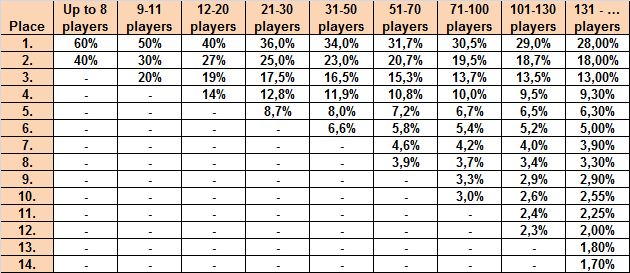 * This structure doesn't apply to satellite tournaments and other special events which payouts will be separately announced.
Olympic Poker Club
* This structure doesn't apply to satellite tournaments and other special events which payouts will be separately announced.
Olympic Poker Club
* This structure doesn't apply to satellite tournaments and other special events which payouts will be separately announced.
Olympic Poker Club
1. Olympic Voodoo Poker Club offers the following games:
Texas Hold’em
Omaha
Five Card Omaha
Seven Card Stud
Five Card Stud (Sökö)
Crazy Pineapple
2. Maximum number of players at the poker table:
Texas Hold’em, Crazy Pineapple – 10.
Omaha, Five Card Stud (Sökö) – 9.
Seven Card Stud, Five Card Omaha – 8.
3. Smoking at the poker tables is prohibited.
4. Players are prohibited from:
Inappropriate behavior towards casino management, staff, and other players.
Interfering with the dealer's conduct of the game in any way.
Throwing cards or chips.
Hiding game chips.
Showing their cards to other participants during the game.
Damaging casino equipment.
Cheating (dishonest play).
Keeping drinks, cigarettes, wallets, and other unrelated items on the table.
5. As a result of a client’s inappropriate behavior, the Tournament Director has the right to:
During cash games, exclude a participant for 10 minutes or prohibit participation in the game and presence in the poker area.
During tournaments, exclude a participant for 10 minutes or longer; fully disqualify from the tournament and prohibit presence in the poker area (if a player is disqualified from the tournament, the ticket money is non-refundable).
6. The Tournament Director has the right to limit the use of mobile phones or other electronic devices at the poker table.
7. Talking on the mobile phone during a hand is not allowed and may result in the Tournament Director declaring the player's cards as a Dead Hand.
8. Spectators are prohibited from commenting, giving advice, or distracting players during the game. Tournament Directors may ban spectators from the poker area if requested by players.
9. All poker games use special chips (tournament chips and cash chips).
10. During the game, players must communicate in a language understandable to both the dealer and the Tournament Director (Latvian, Russian, or English).
11. Players are allowed to play only in their seat and with their own chips, and all decisions related to the game must be made independently.
12. The player is responsible for the security of the cards dealt to them.
13. Participants must not disclose information about their cards to each other.
14. If during the game a participant reveals their cards to another participant, then the rest also have the right to see these cards (Show one - Show all) – even if the participant folds, they must not show the cards to another player, regardless of whether that player is still in the game or not.
15. During the game, players must keep their cards on the table so that they are visible to everyone at the table.
16. If a player holds their cards so that another player can see them, the Tournament Director has the right to warn or consider these cards as a Dead Hand.
17. At the start of card dealing, cards of absent participants will be considered Dead Hands and collected starting from the player after the Big Blind. This rule also applies to players on the Blind positions.
18. If a player wishes to make a bet consisting of several chips, it must be done in one motion. Additional chips placed later are not accepted and such a bet is called a String Bet.
19. If a player makes a String Bet:
If there are already bets on the table, the String Bet is accepted as a Call.
If the String Bet is the first bet, only the first chip touched to the table is accepted.
20. If there are bets on the table and the player without comments places one chip, the value of which is higher than the last bet, this bet is accepted as a Call.
In case the chip value is lower than the previous bet (including All In situations), the following rules apply:
In multi-pot situations (more than 2 players), the player must confirm that this is a Call. If the player does not confirm Call, they lose this bet, cannot raise, but may fold.
In Heads-Up situations – automatic Call.
21. If a player who has the first word in the betting round places one chip without comments, the value of which is higher than the minimum bet, this bet is accepted as the maximum possible bet for the current game.
22. If there are bets on the table and the player without comments places a bet consisting of several chips, which totals at least 50% of the minimum Raise, it is accepted as a Raise; if less, as a Call.
23. If the player has verbally declared the amount of their bet, the bet must be made. In this case, String Bet is allowed.
24. Decisions related to the game are made by players in the proper order. If a player acts out of turn:
Says Check or makes a Bet, this remains valid if the previous player to act checked or folded. If the previous player made a bet, the out-of-turn player may change their decision (Call, Raise, Fold);
Matches a Call or raises, this remains valid if the previous player to act called or folded. If the previous player raised, the out-of-turn player may change their decision (Call, Raise, Fold);
Folds, cards are not returned;
Upon repeated violations of the above points, the player may receive a warning or a game suspension.
25. In Pot Limit and No Limit games, the following minimum Raise rules apply:
The first Raise is always double the last bet.
All subsequent Raises differ from the previous Raise.
26. If a player reveals their cards out of turn, they remain in the game but with limited options – only Check, Call, or Fold. After the hand, the Poker Director issues a warning or excludes the player from the game for 10 minutes. Repeated violations may result in disqualification.
27. At the showdown, players must reveal all their hole cards. The first to reveal cards is the player who made the last Bet or Raise and others have called. If there were no bets in the last betting round (all players checked), the first to reveal is the player first to the left of the Button. Then other players reveal their cards clockwise.
28. Cards Speak – the player with the best combination wins, even if the dealer or player has made an error in determining the combination.
29. Only 5 cards are used to make the combination. The 6th or 7th card cannot determine a win or loss.
30. Suits are not taken into account when determining the best combination.
31. If the pot cannot be divided evenly, the odd chip is awarded:
In Flop games (with Button) – to the first player to the left of the Button;
In Stud games (without Button) – to the first player to the left of the dealer.
32. If there is more than one pot (side pots), the players contesting the last side pot open their cards first (starting from the last side pot and ending with the first).
33. Misdeal is a situation where cards must be shuffled and dealt again. Misdeal includes the following situations:
The first dealt card is accidentally exposed.
More than one card is accidentally exposed during dealing.
The dealer starts dealing from the wrong player.
The dealer skips a player during dealing, making it impossible to arrange cards correctly.
A player is dealt fewer cards than necessary (except if the player is on the Button position and the missing card can be dealt).
A player is dealt more cards than necessary (except if the player is next to the Button and the dealer immediately notices the error; in this case the extra card is taken back and used as a burn card).
34. Claims regarding previous hands are not accepted in a new hand.
35. In case of dishonest play, the casino management has the right to prohibit two or more players from playing at the same table.
36. In case of dishonest play, the Tournament Director has the right to inspect a player's cards.
37. In decision making, the Tournament Director follows fair play rules. For a fair decision in non-standard situations, formal technical rules may sometimes be disregarded.
38. All problems and claims are resolved on site, and the final decision is with the Tournament Directors. Claims not made in a timely manner will not be considered.
1. Only cash chips are used in Cash Game sessions.
2. Bets made in cash are not accepted. Cash can be exchanged for chips only before the start of the hand.
3. To participate in the game, a player must register with the Tournament Director. If the player does not arrive before the game starts, they may lose their seat.
4. A player participating in a tournament cannot register for Cash Game.
5. A maximum of 9 players can play simultaneously at one Cash Game table.
6. The Dealer Button is always used in Cash Game. The Dealer Button is always played before the start of the Cash Game.
7. The minimum and maximum buy-ins are determined by the Tournament Director depending on the game type and blind sizes.
8. A new player can join the game by paying the minimum buy-in. Buy-in can be paid in cash or with cash chips.
9. A new player has the right to choose a free seat at the table. After the choice is made, no one else can claim that seat.
10. A player can change their seat at the table. If the player misses the Big or Small Blind due to seat change, they still must pay the missed bet.
11. If a player misses mandatory bets during seat changes, they must still pay those bets.
12. A new player may start playing by placing a bet equal to the Big Blind (New player’s Blind) or wait until it is their turn to post Big Blind or Straddle.
13. Cards must not be dealt to a player without chips. Cards can only be dealt if the player has chips equal to or greater than the Big Blind amount.
14. During Cash Game, players must be present at the table to participate in a hand. If a player is not at the table, cards will not be dealt to them. If the player misses Big or Small Blind, they must pay the missed bet.
15. Buy The Button means that a player joining between the dealer button and small blind can pay both Big Blind and Small Blind to immediately enter the game and receive the dealer button in the next hand.
16. It is possible to place a Straddle bet in Cash Game: the first Straddle bet and all subsequent Straddle bets are considered Live Straddles. (If a new player joins the game immediately after the SB and BB positions (or after other players' Straddle bets), they may optionally place their own Straddle bet.)
17. During the game, a player may make a Short Buy-in (half the minimum buy-in) no more than once.
18. The table minimum and maximum can be changed only with the Tournament Director/Manager’s approval and if the other players at the table agree.
19. Table stakes means that only chips on the table can be used in the game. Players are not allowed to add or remove chips during a hand, except when paying for drinks, food, or tipping.
20. Players are prohibited from lending or passing chips to each other at the table.
21. During the game, a player is allowed to take a 30-minute break with the Tournament Director’s permission. If a player leaves the table without permission, they may lose their seat.
22. If a player cannot make a decision in a timely manner, the Tournament Director may set a specific time limit for making the decision.
23. If a player leaves the table after finishing the game and returns within one hour, they must sit down with the same amount they had when they left.
24. The casino charges a 5% rake with a cap of €15.
25. The rake is always taken from the Main Pot.
26. If the game ends before the Flop (in flop games) or before the second exposed card (in Stud games), no rake is taken. ("No Flop – No Rake")
27. Run It Twice:
If two or more players have gone All In and the dealer is ready to reveal the remaining cards, players can choose to Run It Twice.
If one player proposes this and all others involved agree, the dealer:
- If players went All In before the Flop, reveals the first Flop, Turn, and River (burning the necessary cards), then burns another card and reveals a second Flop, Turn, and River (again burning the necessary cards).
- If players went All In after the Flop, reveals the first Turn and River (burning cards), then burns another card and reveals a second Turn and River.
- If players went All In after the Turn, reveals the first River (after burning a card), then burns another card and reveals a second River.
In situations with three or more players where there is a Main Pot and Side Pot(s), and one player refuses to play two Flops, other players with Side Pots are allowed to play two Flops, but the Main Pot applies only to the top cards (first Flop, Turn, River).
*If the All In player loses the Main Pot, the other players may play two Flops including the Main Pot.If playing 5 Card Omaha at a Cash Game table, cards can be Run It Twice only if there are 7 or fewer players at the table.
1. A tournament is a competition where players pay a certain entry fee. The prize pool is formed from the collected money and is distributed among the winners according to a specific system. The number of paid places depends on the number of participants.
2. Olympic Poker Club offers the possibility to play different types of tournaments:
Rebuy – a tournament where players can rebuy chips within a certain time period if they run out of chips.
Freezeout – a tournament where players have no option to rebuy chips.
Knockout – a tournament where players receive a cash chip prize for knocking out other players.
3. To participate in a tournament, a player must register and pay the entry fee at the Olympic Voodoo Casino cashier.
4. The casino reserves the right to limit tournament registration rules.
5. If the number of applicants exceeds the allowed number of players in the tournament, a waiting list is created where players can register but can participate only if a spot frees up in the main list:
During the Rebuy period for "Rebuy" tournaments.
At the time designated by the director for "Freezeout" tournaments.
6. The position on the waiting list is individual and cannot be transferred to another person.
7. The tournament takes place only if there are at least 4 participants. Otherwise, the tournament will be canceled and those who have already paid can get a refund.
8. At the start of the tournament, all participants receive an equal amount of tournament chips. These chips can be used only in the tournament and have no cash value.
9. Players are forbidden to give their chips to other players.
10. Players are forbidden to take chips outside the casino premises.
11. Seats at the table are drawn among all tournament participants. Players are not allowed to exchange assigned seats.
12. Players must play the tournament themselves – using another player to play on their behalf is forbidden. Also, giving advice to spectators or other players on decision-making is prohibited.
13. If a player has paid the entry fee but is known to be late, their chips are played in the tournament with the others. The dealer posts all forced bets on behalf of the late player.
14. A player can get a refund of the paid entry fee in the following cases:
If the tournament is canceled for some reason.
If the player notifies that they will not attend the tournament before it starts and has a valid reason with the tournament director's approval.
15. A player who has left the table still receives cards and must post Ante or Blind bets. The dealer has the right to post forced bets for the absent participant.
16. Cards are dealt to all tournament participants regardless of whether the player is present or not.
17. If a player is not at the table after the first card is dealt, their cards are immediately mucked, even if the player is in a blind position.
18. Minimum bets (Small/Big Blind, Ante, Forced Bet) increase according to a predetermined schedule.
19. During the tournament, all tables must have an equal number of players. The number of players at the tables is regularly adjusted as players leave the tournament.
20. Table balancing is done as follows: the player who finishes the game vacates their seat, which is taken by the player in the BB position.
21. Seats from a disbanded table are always drawn by lot.
22. Seats at the final table are always drawn by lot.
23. During table balancing, players must immediately move to their assigned seats.
24. If two or more players leave the tournament, their seats are assigned based on chip count (the player with more chips takes the better seat).
25. When only two players remain in the tournament, the player with the Button posts the Small Blind and the other posts the Big Blind. These rules apply to Heads-up tournaments as well.
26. Bets, levels, and starting chip stacks (tournament structure) are planned in advance, and every player can receive this information before the tournament starts.
27. The casino reserves the right to change the planned tournament structure before the tournament begins, and all participants must be informed beforehand.
28. If a player takes too long to make a decision, any player at the table may request the Tournament Director to grant 30 seconds of “Time.” If after the minute the player still hasn't made a decision, the director starts a 10-second countdown. After the countdown, the player's hand is automatically considered a Dead Hand (Fold). (In Turbo tournaments, this time is 15 seconds).
29. Time” can only be requested by a player for the table they are playing at. The Tournament Director may refuse the request if deemed unnecessary.
30. Manipulating the “Time” request is forbidden, and violations may result in warnings or penalties.
31. Only tournament chips are allowed on the table during the tournament, except for chips used as “Card Cap” (a chip or talisman of luck) or cash chips used as Terminator chips in Terminator tournaments.
32. Hand rankings are determined only by revealed cards. Combinations verbally announced by players are not valid.
33. After the designated level time expires, the next level begins with the next deal. If the dealer has started shuffling (strip shuffle), the current hand is played with the old blinds.
34. Folded cards are immediately moved to the muck and no one has the right to look at them.
35. If only one player is left for a prize or ranking point, dealing across all tables happens simultaneously until one player leaves the tournament (international tournaments).
36. If the dealer collects a player's cards who did not protect them, that player cannot get back the chips they have bet. The exception is if the player made a Raise and no one called.
37. If a player moves from a disbanded table to another and is between Small Blind and Button, they miss that deal, and the Button moves past them to the next player in the next deal.
38. Players are forbidden to comment on possible combinations related to folded or hole cards.
1. Freezeout Tournaments
At the start of the tournament, all players receive an equal number of chips. No rebuys are allowed. Once a player loses all their chips, they are eliminated. The game continues until one winner remains.
2. Rebuy Tournaments
Within a specified time period, players have the opportunity to purchase additional chips (rebuy) if they run out. After the rebuy period ends, the tournament continues as a freezeout.
3. Re-entry Tournaments
After being eliminated, a player can re-register for the tournament by paying the buy-in again. Unlike a rebuy, the player starts fresh, often at a different table.
4. Add-on Tournaments
At a specific point (usually after the rebuy period), players can purchase additional chips (add-on). To make an add-on, the player must have at least one chip. If they have none, they must first rebuy before adding on.
5. Unlimited Rebuy Formats
Unlimited Rebuys: Players can rebuy an unlimited number of times up to the starting chip amount, if their stack is equal to or lower than the starting stack. Only allowed during the rebuy period and between hands.
Unlimited WILD Rebuys: Players can rebuy unlimited chips regardless of their current stack size.
6. Double Chance Tournaments
At the beginning, players receive half of their total starting chips. The other half can be requested once, for free, at any point during the first three levels—only between hands.
7. Sit & Go Tournaments
The tournament begins as soon as a specific number of players register (e.g., 6, 9, or 18). There is no scheduled start time. These tournaments are smaller and faster.
8. Multi-Table Tournaments (MTT)
Large tournaments with many players split across multiple tables. As players are eliminated, tables are consolidated until one final table and one winner remain.
9. Satellite Tournaments
Winners receive entry tickets to another, higher buy-in tournament. This is a great way to qualify for prestigious events at a lower cost.
10. Bounty Tournaments
Players receive a cash reward for eliminating other players. Part of the buy-in goes toward the bounty pool.
11. Progressive Knockout (PKO)
A special bounty format. When a player eliminates another, they receive 50% of the opponent’s bounty as a reward, and the other 50% is added to their own bounty. The more players they knock out, the higher their own bounty becomes.
12. Mystery Bounty
For each eliminated player, a random (mystery) prize is awarded. The value is revealed only after the elimination, adding excitement and unpredictability to the game.
13. Double or Nothing Tournaments
Half the players double their buy-in, and the other half win nothing. The tournament ends when the required number of players are eliminated.
14. Turbo and Hyper-Turbo Tournaments
Turbo: Blind levels increase faster than in standard tournaments.
Hyper-Turbo: Blind levels increase even faster, making the pace of play much more aggressive.
15. Deep Stack Tournaments
Players start with a larger-than-usual amount of chips compared to the blinds. This allows for deeper strategy and longer gameplay.
16. Terminator Tournaments (Life Chip)
A freezeout variant where each player also receives a Life Chip with a cash value. If a player goes all-in and loses, their Life Chip is awarded to the opponent. Every time a player goes all-in, they must include their Life Chip if they still have it.
17. Big Blind Ante (BBA)
In BBA tournaments, only the player in the big blind pays the ante, which speeds up gameplay and reduces dealer error.
Priority: If a player doesn't have enough chips for both the big blind and the ante, the big blind is paid first, and the ante only if chips remain.
18. Ante Only No Limit Texas Hold’em
In this format, players only pay antes in each hand—there is no small or big blind.
These formats offer diverse gameplay dynamics, strategic challenges, and prize distribution models—making poker tournaments engaging and suitable for players of all styles and experience levels.
This is the most popular and simplest version of poker. Players are dealt two cards each, and five community cards are revealed on the table. Players can form a five-card combination using one or both of their own cards together with the community cards. The game consists of four betting rounds, starting from the position after the Button, which moves one step clockwise after each hand.
Blinds
Before the game starts, and before players are dealt cards, two players after the Button place forced bets called Blinds. Blinds are necessary to ensure a starting amount in the pot. The first player after the Button posts the Small Blind, and the second posts the Big Blind. The Big Blind is usually twice the size of the Small Blind.
Pre-Flop
Players are dealt two hole cards. After the cards are dealt, the next player after the Big Blind starts the betting round. This player can call (match the previous bet), raise (increase the bet), or fold (discard their cards and leave the hand). When the action reaches the Big Blind, they can check (continue without adding more chips) if no raise was made. If there was a raise, the Big Blind can fold, call, or re-raise. Once all bets are matched, the dealer collects the bets and the next round begins.
Flop
Three community cards are dealt face up on the table. Players can use these cards to form their combinations. After this betting round, the game continues.
Turn
The fourth community card is dealt face up, followed by the next betting round.
River
The fifth and final community card is dealt face up, followed by the last betting round.
Showdown
After the final betting round, players reveal their cards to determine the winner. To claim the pot, a player must show both hole cards. If two or more players have identical combinations, the pot is split equally.
This game is very similar to Texas Hold’em, but unlike Texas Hold’em, players are dealt four hole cards, and five community cards are dealt on the table. Players must use exactly two of their hole cards and three of the community cards to form their five-card combination. The game has four betting rounds, starting from the position after the Button, which moves clockwise after each hand.
Blinds
Before the game starts and cards are dealt, two players after the Button place blinds to ensure a pot. The first player after the Button posts the Small Blind, the second posts the Big Blind, which is usually twice the Small Blind.
Pre-Flop
Players are dealt four hole cards. The player after the Big Blind starts the betting round, with the options to call, raise, or fold. The Big Blind can check if no raise was made or fold, call, or raise if there was a raise. After all bets are equalized, the dealer collects the bets and the next round begins.
Flop
Three community cards are dealt face up. Players use these cards with their hole cards to form combinations.
Turn
The fourth community card is dealt face up, followed by a betting round.
River
The fifth community card is dealt face up, followed by the final betting round.
Showdown
After betting ends, players reveal their cards. A player claiming the pot must show all their hole cards. If players have identical hands, the pot is split.
Until recently, 7 Card Stud was the most popular poker version until Texas Hold’em overshadowed it. This variant differs from Texas Hold’em and Omaha and requires patience, but is very engaging.
Before the game starts, players place mandatory Ante bets. There are no community cards in Stud poker. Instead, the dealer deals three cards to each player clockwise. The first two cards are dealt face down and the third face up.
There are five betting rounds that proceed clockwise.
Betting start
The player with the lowest (in Split Limit) or highest (in Pot Limit) visible card starts and places the initial bet. If two or more players have the same rank, suit order is used: clubs, diamonds, hearts, spades.
3rd Street
After the initial bet, each player can fold, call, or raise up to the limit, starting left of the bettor.
4th Street
A fourth card is dealt face up. The player with the best visible hand starts the betting round and can double the bet if they get an up pair.
5th Street
The fifth face-up card is dealt. The player with the best visible hand starts betting.
6th Street
The sixth face-up card is dealt. The player with the best visible hand starts betting.
7th Street or River
The last, seventh card is dealt face down. The player who started the previous round begins betting.
Showdown
The player with the best five-card hand wins.
Each player is dealt two cards: the first face down (hole card) and the second face up. The hole card is hidden from other players.
There are four betting rounds. After dealing the first two cards, the first betting round begins. Then the third, fourth, and fifth cards are dealt face up, each followed by a betting round.
Players place an obligatory Ante before dealing.
Bring-in
The player with the lowest (Split Limit) or highest (Pot Limit) card starts and places the initial bet. If tied, suits decide in alphabetical order: clubs, diamonds, hearts, spades.
Betting order
Soko has four betting rounds. After the first two cards, the first betting round starts. Then each new card is dealt with a betting round after.
Showdown
When betting ends, players reveal cards and the best five-card combination wins. In case of ties, the pot is split equally. Any leftover chip goes to the player left of the dealer.
The player who last bet or raised reveals the first card. If no bet was made, the active player left of the dealer reveals first.
Soko hand rankings (strongest to weakest):
- Royal Flush
- Straight Flush
- Four Of a Kind
- Full House
- Flush
- Straight
- Three of a Kind
- Two Pairs
- 4 cards Flush
- 4 cards Straight
- One Pair
- High Cards
This game is very similar to Texas Hold’em, but players are dealt three hole cards instead of two, and five community cards are dealt. Players can use one or two of their hole cards to form a five-card combination with the community cards.
There are four betting rounds, starting from the player after the Button, which moves clockwise each hand.
Blinds
Before dealing, two players after the Button post blinds: Small Blind and Big Blind, usually twice the Small Blind.
Pre-Flop
Players are dealt three hole cards. The player after the Big Blind starts betting with options to call, raise, or fold. The Big Blind can check if no raise, or fold, call, or raise if there was a raise. Once bets are equalized, the dealer collects bets and next round begins.
Flop
Three community cards are dealt face up. Players use them to form combinations. After the second betting round, players must discard one of their hole cards.
Turn
The fourth community card is dealt face up, followed by a betting round.
River
The fifth community card is dealt face up, followed by the final betting round.
Showdown
After the last betting round, players reveal their cards to determine the winner. Players must show both remaining hole cards to claim the pot. If tied, the pot is split.
5 Card Omaha is an exciting Omaha variant. It is played like Omaha but players are dealt five hole cards. In 5 Card Omaha, players must use exactly three community cards from the flop and exactly two hole cards to form the best five-card poker hand.
Dear poker players,
Poker tournaments payout structure in Olympic Poker Club is following:
* This structure doesn't apply to satellite tournaments and other special events which payouts will be separately announced.
Olympic Poker Club
* This structure doesn't apply to satellite tournaments and other special events which payouts will be separately announced.
Olympic Poker Club STILL HAVE QUESTIONS?
Can’t find the answer you’re looking for? Please chat with our friendly team.
